Half His Age is a terrible book

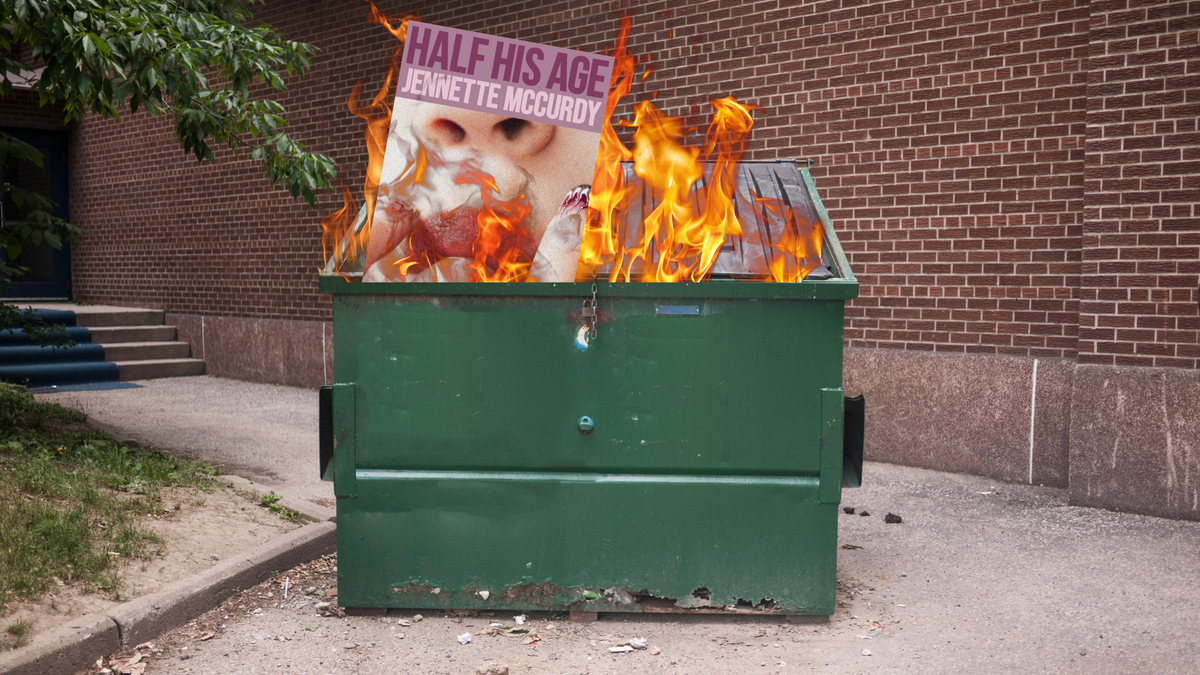
Half His Age was one of my most anticipated book releases of 2026. When I learned that Jennette McCurdy – whose breakout memoir I'm Glad My Mom Died I absolutely loved – was releasing a novel with female rage as a central theme, I was SAT.
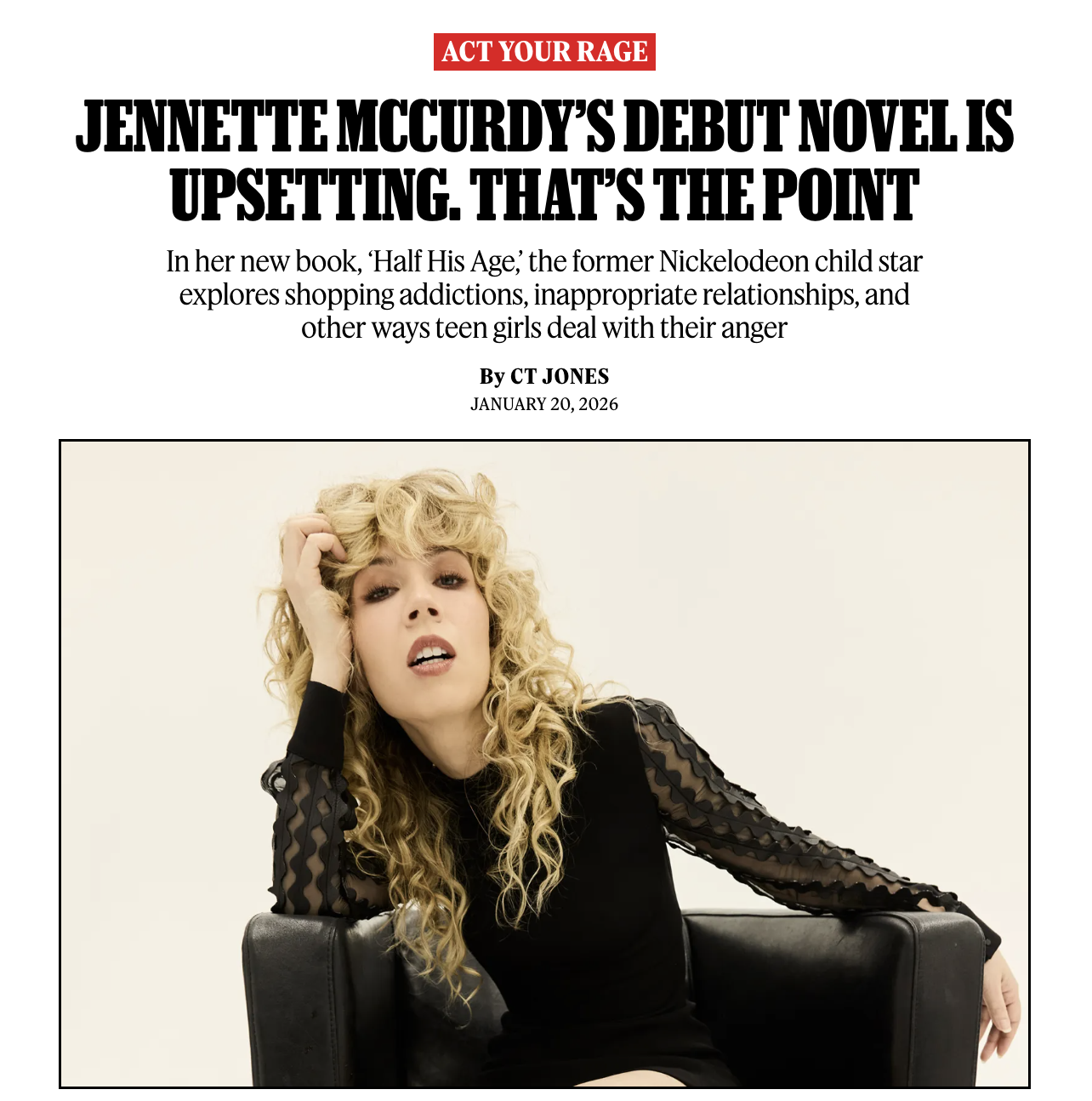
The book's blurb describes Half His Age:
Waldo is ravenous. Horny. Blunt. Naive. Wise. Impulsive. Lonely. Angry. Hurting. Endlessly wanting. And the thing she wants most of all? Mr. Korgy, her creative writing teacher.
Mr Korgy, with the wife and the kid and the mortgage and the bills, with the dead dreams and the atrophied looks and the growing paunch. She doesn’t know why she wants him. Is it his passion? His life experience? The fact that he knows books and films that she doesn’t? Or are they actually kindred spirits, sharing the same filter with which they each take in the world around them? Or, perhaps, it’s just enough that he sees her when no one else does.
Startlingly perceptive, mordantly funny, and keenly poignant, Half His Age is an incisive study of a yearning seventeen-year-old who disregards all obstacles in her effort to be seen, to be desired and to be loved.
I counted down the days to its release, and on the day of I planned my weekend around securing a copy and clearing my schedule to devour it as quickly as possible because I was sure I would love it and be unable to put it down.
Well...I tried. I really tried.
By the second (short) chapter, I thought I must be missing something, because I was not enjoying it like I thought I would. I started looking up other reviews and thought I was going crazy because everywhere I looked people were raving about it. I kept trying to persevere, hopeful that it would get better and I would finally understand what so many people were loving about it.
But alas, it did not get better. In fact it was so bad I DNF'd it after just 21 pages.
Tyra Banks said it best.
For so many reasons Half His Age is not a good book. I'll go into more detail shortly, but in a nutshell:
It's like if you asked ChatGPT to rewrite My Dark Vanessa in the style of Ottessa Moshfegh and Mona Awad and then ran it through HemingwayApp to knock it down to a Grade 4 reading level.
My main issue with this book is how poorly it was written. In my opinion, there are no excuses for this when the author has been paid a likely eye-watering advance (that would be life-changing for other unknown, debut writers), and has all the resources at their disposal to craft something truly outstanding. A writer of McCurdy's note would have had access to some of the strongest editors who really should have done more to help this book become what it was promised to be. This is actually insane too when apparently she spent two years writing it and worked through more than 20 drafts in the process.
Reading Half His Age reminded me of this quote I saw recently, drawn from the original by Nathaniel Hawthorne: "A book that is easy to read is hard to write, and a book that's hard to read is easy to write."
Let's just say that Half His Age was certainly not easy to read.
There are so many ways Jennette McCurdy shows that she is either a). an incompetent and inexperienced writer, or b). rushed through this novel without giving enough time to editing and rewriting. There are three main points I'm going to cover off below and just a note, I quit this book long before I got to the gratuitous sex scenes (which I've heard are purely vile, based on other reader's reviews), so I will be focusing solely on the GLARING issues I experienced within the very short time I spent with this book before yeeting it into the sun.
The fucking grammar oh my god
Does Jennette McCurdy know that there is a vast array of punctuation options available to choose from in the English language? That full stops are not the only way to show a change in a sentence or indicate a pause?
Take this passage for example:
But this time I actually went to church with them. Borrowed one of Frannie's puffy-sleeved pastry dresses that itched all through Sacrament meeting. Then I attended class with her. And the lecture was on befriending the friendless. And how generous that is. What good charity work it is. How you curry favor with God for doing it. And I looked over and Frannie's eyes were lit up with recognition, hearing herself in the words and she sat at the edge of her seat, almost falling off from the sheer, eager, do-gooder-ness. I realized I was the friendless she had befriended. A hole-punch on her God stamp card. A fixer-upper to her savior. I was charity work.
I see what she’s trying to do here in terms of making Waldo sound blunt, detached and direct, and contrasting that with the starry-eyed feelings of the character Frannie, but repeated throughout the book it makes for painful reading and highlights McCurdy's inexperience as a writer.
You can show that a character is all of those things (blunt, detached and direct), and still have the work be an enjoyable experience for the reader.
A truly skilled writer can demonstrate a fucked up and emotionally repressed character without punching the reader in the face every five or six words. Ottessa Moshfegh is the absolute master of this. Take this excerpt from My Year of Rest and Relaxation:
Nothing seemed really real. Sleeping, waking, it all collided into one gray, monotonous plane ride through the clouds. I didn't talk to myself in my head. There wasn't much to say. This was how I knew the sleep was having an effect: I was growing less and less attached to life. If I kept going, I thought, I'd disappear completely, then reappear in some new form. This was my hope. This was my dream.
The narrator in My Year of Rest and Relaxation at face value throughout the novel, can be read to be completely devoid of empathy and emotion, and even cruel in her interactions with her friend Reva. However because of how beautifully and thoughtfully constructed Moshfegh’s sentences are, the reader is also aware of the underlying mental and emotional pain the character endures throughout the novel.
The narrator reads as a complex and layered character with nuance, depth and interiority:
Sleep felt productive. Something was getting sorted out. I knew in my heart—this was, perhaps, the only thing my heart knew back then—that when I'd slept enough, I'd be okay. I'd be renewed, reborn. I would be a whole new person, every one of my cells regenerated enough times that the old cells were just distant, foggy memories. My past life would be but a dream, and I could start over without regrets, bolstered by the bliss and serenity that I would have accumulated in my year of rest and relaxation.
All of this is achieved through carefully crafted syntax that flows seamlessly, with each sentence supporting the next to propel the story forward.
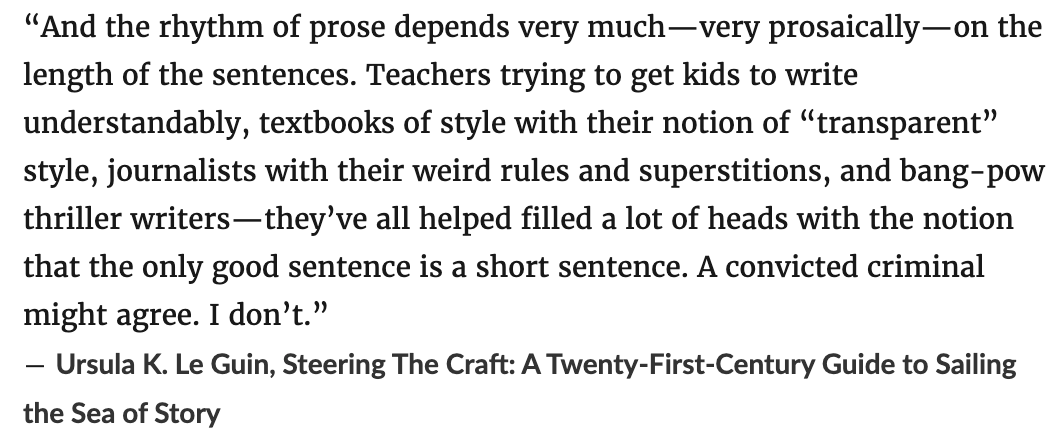
In Half His Age, rather than working as an effective narrative device, McCurdy’s short, blunt sentences are jarring and grating. They stop the reader in their tracks and distract from any potential substance within them. It's a juvenile and cheap tactic that speaks to inexperience, poor guidance from editors, and a lack of understanding on McCurdy's part of the tools available to the writer within the realm of grammar to portray the idiosyncrasies of the character. Perhaps McCurdy should have spent more time reading and studying the works of a wide range of writers to better understand how they use language strategically to convey themes and characteristics. (Ursula Le Guin's Steering The Craft has an excellent chapter dedicated entirely to the art of skilfully selecting punctuation for each sentence, and why it is such a critical – and often overlooked – part of the craft.) I am surprised McCurdy's editor didn't push back on this either.
It's cliched, overwritten, and leaves no room for reader interpretation
In the same way that her rampant overuse of the full-stop reeks of inexperience, Half His Age has absolutely ZERO nuance and relies heavily on telling us what is going on, rather than showing us. I know that writing "rules" are to be taken with a grain of salt, and that the advice to "show, not tell" does not always apply to every scene and every story, but in giving away every single piece of information up front Jennette McCurdy robs the reader of any chance to make inferences or offer any glimpse into the interiority of her characters.
For example:
I order the same shades of cream blush stick that she did, except for Venetian Rose, which is sold out and would've looked too harsh on my pale skin anyway. I know that a blush isn't gonna transform my life, but it's still nice to believe during the three-day shipping time that it could. It's nice to believe that the only difference between me and Margot Robbie is a stick of blush. It's nice to believe promises, even empty ones in cute typefaces on the backs of little cardboard packages. Especially those ones. There's something about how assured they are in the those pretty little fonts that feels more credible than the ones coming out of people's mouths.
This entire passage did not need to make it into the final copy. Or not in its current form anyway. This is a missed opportunity to highlight Waldo's interiority and offer the reader the chance to form an opinion on what the impulse-buy means and says about Waldo as a character.
Mona Awad is the queen of writing about the power of transformation. In her recent short story titled The Chartreuse, published in The New Yorker on July 20 2025, she writes about a woman who misses the delivery of a dress she ordered online and becomes increasingly obsessed with the item as she awaits redelivery. The following passage from The Chartreuse is an excellent example of how Awad expertly demonstrates the desire for transformation within an object/purchase and what that says about the narrator:
Ridiculous to be upset about the chartreuse. Just a delayed delivery. Just a dress. Not even the right color for her, probably. Probably in the end she’d have to send it back. “The truth,” she told the sidewalk, “is that I didn’t even want it.” It had been an impulse buy from Farfetch, one of those sites along with Mytheresa and The RealReal which she’d been haunting with increasing frequency. She’d been in search of a new Mage, a particular type of dress, the namesake design from the label. She’d been hunting those dresses for a few months now. High-end, French, chicly esoteric. Prized for their saturated jewel-toned colors, their impossible falls and cuts. She’d already acquired several lengths and shades: rust, forest, jade, and four more blues beyond sapphire—azure, pigeon, powder, royal.
'It’s the material', she thought as she scoured the web for more. That’s what’s winning me over. Or is it the cut?
She had bought the first one, the sapphire, at an actual shop in New York, just before she left her job, set her life on fire. When she tried it on in the dressing room, she’d felt a shiver as she looked at herself in the mirror. Yes, she’d murmured to her reflection. This.
(Note how Awad also strategically uses short sentences to drive the story forward instead of just ramming them in everywhere for some sort of failed "effect".)
McCurdy constantly misses opportunities to add dimension to Waldo as a character by stating the obvious and telling us exactly what she's thinking all the time. It becomes a boring stream of consciousness that leaves nothing to excite the reader or provoke curiosity. I have zero desire to get to know Waldo any further because I feel like I already know everything I need to know to deduce that she is not a character that I care about or that holds any interest to me.
I think the reason for this lack of depth and nuance in Waldo is due to two things: firstly, McCurdy lacks experience as a writer and plainly needs to just read more books. Secondly, McCurdy is said to have based this story on her own personal experience, leading me to believe that she adhered too rigidly to the sequence of events in her own life rather than allowing the FICTION part of the story to become realised. (Florence Given did something similar with her absolute abomination of a book Girl Crush, which flopped so hard she basically pretends it never happened.) The potential of Half His Age is stifled by Jennette McCurdy's heavy-handed approach to retelling the events in her own life. She might have changed the setting, but there is no room for the story to breathe, grow and develop on its own with nuanced and layered characters.
McCurdy should have just worked this out with her therapist
This book has been heavily marketed as seeking to "start conversations on female rage," as though authors like Han Kang, Ottessa Moshfegh, Mona Awad, Eliza Clark, Shirley Jackson, and many, MANY more haven’t already been doing this for decades.
But more to the point...this book is actually just not about female rage at all?
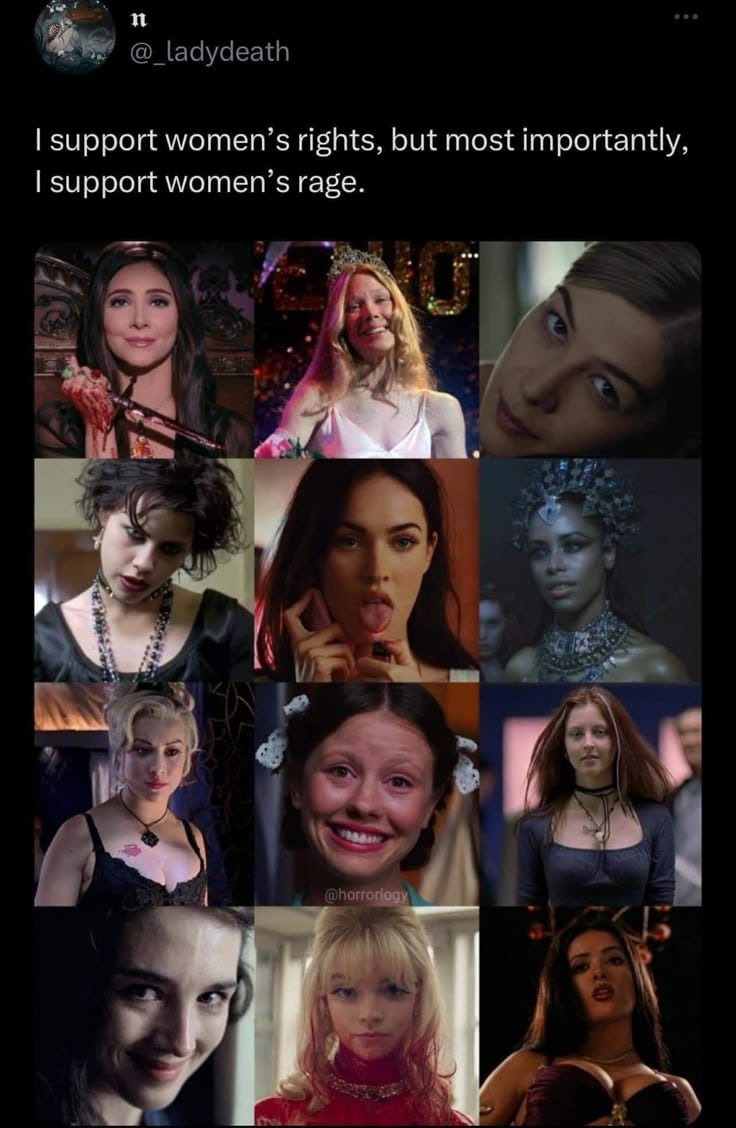
If you're reading this you're probably already intimately familiar with the expectations of a book within the 'female rage' – or 'Good For Her' – genre. Typically we would see some sort of character evolution that involves a move towards freedom and catharsis. This transformation is not always carried out in such a way that would be considered "healthy" or "normal" by polite society, but it almost always speaks to some deeply felt (and suppressed) shared experience or desire by most women who read it.
Half His Age does not do this. Waldo's motivations, aside from the obvious of pursuing Mr Korgy, remain murky and scattered at best. We do not root for Waldo or care about her, or see her rage expressed really in any way at all. There is no revenge or self-destruction that provides an outlet for her to tear down whatever systems are fuelling her discontent. McCurdy has stated that writing this book allowed her to work through her own rage at what she experienced as a teenage girl who was taken advantage of by a much older man in a position of power, but those emotions failed to be fully realised in this book.
As one friend of mine so eloquently put it: it has a female in it and she does get angry sometimes?? it's about a topic that makes women angry?? but a book about female rage that does not make??
One thing I will say is that I am a female and I did feel rage reading it – but probably not for the reasons McCurdy was hoping.
What is McCurdy adding to this conversation exactly? As many other reviewers have pointed out, without any character development or emotional payoff or transformation, the point of this book and its intended market remain unclear. If writing this book was purely an avenue for McCurdy to work through her shit, vent her own frustration and find catharsis then girl, get a fucking diary.
The "unlikeable female character"
The "unlikeable female character" often goes hand in hand with the "Good For Her"/"female rage" genre. Usually she's unlikeable because she's acting in ways considered contradictory to society's typical expectations of a "well behaved woman," often in the pursuit of revenge or simply acting on her intrusive thoughts and repressed urges. She's "unlikeable" to the patriarchy but to women reading her, she's a fucking inspiration, or at the very least we're rooting for her because she's doing the things we've only ever fantasised about doing. Waldo fails to fit this category of "unlikeable female character," and not in some clever or subversive way. She's just boring. She's not some anti-hero that we can see ourselves in, she's vapid and shallow and entirely unrelatable.
It’s a real shame because this theme of informed consent and the power dynamics of age-gap relationships, is a really interesting one to explore and I think this concept as a novel could have been excellent especially in the context of Hollywood and child stars. With a good editor and more time, perhaps the ultimate version of this book could have been realised, but that is the issue with publishing famous names. There is a tendency to hype the shit out of them, rush through the writing process and then completely disappoint upon release. McCurdy clearly has some writing talent too based on the success of her memoir, so I’m sure if she had been given the time and guidance from the right editor, she could have pulled this book off.
I keep asking myself why I'm so enraged by this book – enough to write over 3,000 words about it – when I only read 10% of it. Aside from the fact that it was atrociously written and yet has had one of the biggest, most public global press tours I've ever seen for a novel, I think it's that if it were anyone other than Jennette McCurdy, the possibility of publishing this book would never have even been entertained by any publisher. There are so many incredibly talented writers deserving of the time, money and platform to produce their art as what has been afforded to McCurdy and it all feels so grossly unjust that such a painfully average piece of work is all there is to show for it.
I know there will be people who say that the book and its short sentences and blunt language is meant to make you uncomfortable, that that's the point. But I do not accept that these poor grammatical and narrative choices are just part of what it takes to portray an angry, unlikeable character. I have read a lot of uncomfortable shit with deeply disturbing scenes (the grape scene in Lapvona, anyone?) and I know that provoking discomfort and how it challenges you as a reader is not the same as provoking disgust purely for shock factor without some deeper meaning behind it or ultimate payoff. If you are seeking to disturb and upset your reader, there should be a valid reason for it that serves the motivations of the character and the story. Half His Age did not have this. It appears to want to shock purely for the sake of it rather than driving the narrative forward.
Perhaps I shouldn't be surprised that this book was so extraordinarily bad. White cis women with influence/a huge following have been writing and publishing the worst book you'll ever read since the dawn of time (see: Haley Pham and the aforementioned Florence Given). But I really thought Half His Age would be different, given how much I enjoyed McCurdy's memoir.
I am sorry for what Jennette McCurdy went through in her own life with a fucked up, coercive age-gap relationship, but we can still accept that this book is not well written. If she wanted to explore and unpack her own experience she should have written another memoir or an essay collection as non-fiction is clearly her strong suit. Or just gone to therapy. I don't know.